The N+1 Unknown Executor Problem
Distributed execution is not a sequence of positions. It is a sequence of causal steps across time.
A workload does not exist because it is next in a list. It exists because it was provisioned at a specific moment, in response to a specific event. It becomes an executor in an authority propagation only if it can securely carry that authority forward as a valid continuation of the execution chain.
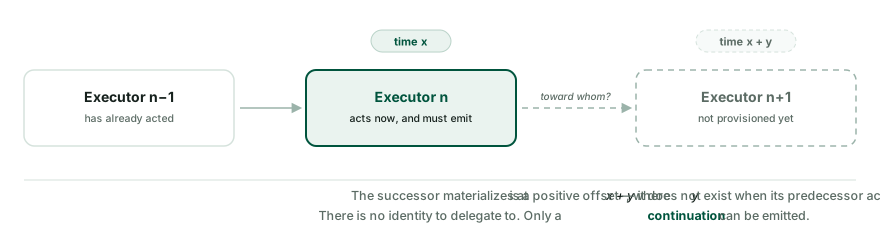
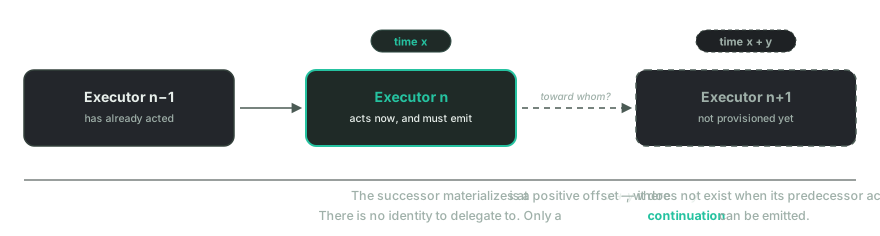
When Workload n receives a message at time x, Workload n+1 is provisioned at time x + y, where y is a positive offset. The gap is real: the downstream executor does not exist yet when the upstream executor acts.
This is the N+1 unknown executor problem: authority must reach a successor that is not yet known, selected, or provisioned when the predecessor acts. Pre-binding authority to the holder, key, or channel of an unknown successor is therefore not always possible.
This has three consequences:
- Authority flows from origin — never re-created: within a chain, there is no moment where a new workload can bootstrap its own authority. Authority must arrive causally from what came before.
- Every hop must prove continuity, not possession: holding a token is not enough. The workload must demonstrate it is a valid continuation of the execution chain.
- Execution is temporal and causal, not positional: the chain is defined by what happened and when — not by topology or configuration.
This is why possession-based models are incomplete for distributed execution. They assume the chain is synchronous and positional. It is not.
The Canonical Execution Model
This problem is categorized by the Canonical Execution Model: execution as a causal chain in which each executor may come into existence only after its predecessor has acted. A system that claims to satisfy authority propagation MUST be designed and tested against the canonical execution model — if it works only when the whole chain is known in advance, it does not solve authority propagation.
Authority Continuity
In PIC, a transition between execution steps is valid only if two conditions hold at that hop:
- Causal relationship: the step is a valid causal continuation of its immediate predecessor within the same execution lineage, witnessed by a Proof of Relationship (PoR) — single-hop evidence binding the executor to the step that came before it.
- Monotonic authority restriction: the authority carried forward is a restriction of the authority held at the previous hop — it may remain identical or decrease, but it never expands.
At a glance:
valid hop = Proof of Relationship + non-expansion
valid chain = Proof of Continuity
Composed transitively along the chain, these valid transitions form a Proof of Continuity (PoC): the proof that the entire lineage, from origin to current state, is unbroken and monotonic. Relationship is local; continuity is global.
From these two conditions the guarantees follow: provenance remains traceable from origin to current state, the origin principal p₀ is preserved throughout the chain, and authority cannot be re-created mid-chain, cannot escape its origin, and cannot expand across any dimension. At a conforming receiving boundary, the confused-deputy state is not valid PIC state.