Why PIC
Provenance Identity Continuity (PIC) has its roots in distributed systems. Its core idea is simple: when execution cannot be trusted to select authority correctly, propagated authority should be accepted only as a verifiable, non-expansive continuation of the authority it came from — not merely because a credential is valid and possessed.
At a glance:
| PIC asks | PIC requires |
|---|---|
| Does this authority belong to this execution? | A Proof of Relationship to the predecessor. |
| Did authority expand? | A successor context bounded by the predecessor. |
| Can the chain be trusted from origin to now? | A Proof of Continuity over the lineage. |
The practical problem
The problem that led to PIC first appeared in stream processing. In an Apache Kafka pipeline, authority had to be propagated to a consumer that was not yet known. Passing a bearer access token through the stream looked natural, but the consumer might not yet exist, might receive the message after the token had expired, or might not hold the key required to decrypt it.
In that architecture the practical workaround was to give the consumer its own credentials. That solved the delivery problem, but introduced a different risk: a consumer serving many requests could hold broader authority than any single request required, leaving application code to choose which authority to use. A defect, a compromise, or an incorrect association could then cause valid authority to be used in the wrong execution context.
What the problem revealed
The first conclusion — that the conventional bearer access token was itself the problem — was too broad. Bearer-token protocols work correctly within their stated scope and threat model. What that architecture required was an additional property which the flow in use did not establish: a receiver-verifiable relationship between propagated authority and the execution for which it was granted, plus a check that the successor authority did not expand.
The missing property at a glance
| Question | Why it matters |
|---|---|
| Is the credential valid? | Necessary, but not sufficient. |
| Who possesses it? | Possession does not establish which execution it belongs to. |
| Which execution may continue? | This is the Authority Continuity question. |
| What should the receiver verify? | PoR + non-expansion, and any profile-required request, integrity, and freshness checks. |
Why this matters for AI agents
An AI agent may hold several valid permissions at the same time. The security question is not only whether those permissions are authentic, but whether the authority selected for the next action is validly attributable to the execution being continued.
Under this threat model, delegation alone reaches its limit at the moment of choice. Delegation transfers permissions and constraints, but it does not prove that an untrusted executor selected the correct authority for the current task.
"Can this execution prove that it is the next valid continuation of the authority it received?"
A receiving boundary should accept only a verified continuity advancement. That is Authority Continuity, and PIC is one construction for it.
The governance of choice
Distributed systems teach that unavoidable trade-offs should be made explicit. In agentic authorization, three concerns interact: authorization protocol, freedom of choice, and supervised choice.
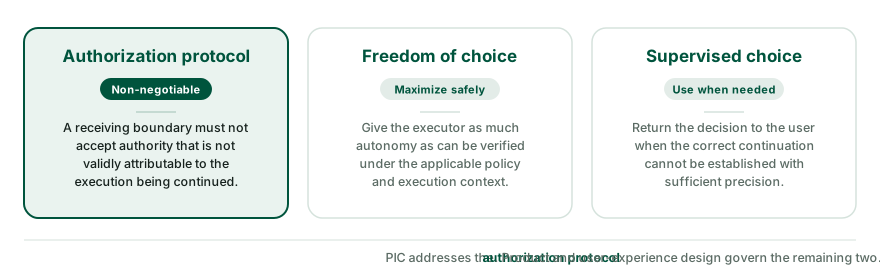
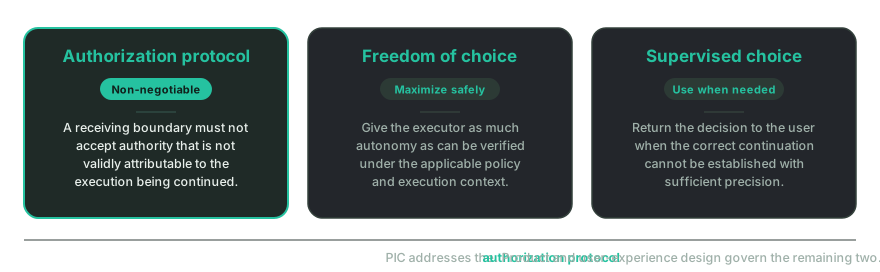
PIC addresses the authorization-protocol part of this trade-off by removing authority selection at that layer and converting it into a verifiable proposal that the receiving boundary can accept and use to permit the continuation.
Product and user-experience design must govern the remaining choice between safe autonomy and human supervision. The goal is to preserve as much freedom as can be verified, escalating to the user only when a safe continuation cannot be established.
An ontological shift
PIC changes the role of delegation. Instead of delegating the authority to make an unconstrained choice, it allows the executor to propose a continuation. The receiving boundary then verifies whether that proposal is among the permitted options, and whether it preserves the required relationship with the authority and execution being continued.
| Delegation alone | With PIC | |
|---|---|---|
| The executor's act | "Choose which authority to use." | "Propose a continuation that the next boundary can verify." |
| Who decides | The executor, internally | The receiving boundary |
| What is trusted | That selection was performed correctly | Nothing — the proposal is verified |
| What is checked | The credential is valid and possessed | The advancement has PoR, preserves lineage, and is non-expansive |
The receiving boundary decides whether the proposal is admissible under the applicable policy, authority constraints, and verification rules. Authority may only be preserved or attenuated, never expanded.
A practical illustration
AI agents can hold and use multiple credentials across different tasks and execution contexts. The security question is not only whether a credential is valid, but whether its use is validly attributable to the execution currently being continued.
An agent holding credentials for two tenants, two customers, or two workflows is one incorrect association away from acting with authority that is entirely valid — and entirely unrelated to the request it is serving. No credential check detects that: both credentials are authentic, and both are legitimately held. Only a continuity check — PoR plus non-expansion over the lineage — can distinguish them.
The threat model
None of the above is an absolute claim. It holds under a stated perimeter: transport is untrusted, execution is untrusted and has no required global mediator, executions may overlap or retain state, the successor may not exist yet, and a receiver must be able to reject a state that validates but does not belong to the execution being continued.
That perimeter — and the receiving requirement it produces, execution-context non-mixing — is stated in full on its own page.
The scope, stated
PIC addresses the authorization protocol by requiring a verified continuity advancement instead of relying on the executor's internal authority selection. The boundary of that claim is part of the model, not a caveat added to it.
| PIC establishes | PIC does not claim |
|---|---|
| Propagated authority is accepted only as a verified continuity advancement of the execution it came from | That an executor's subjective intent can be proven |
| Authority is preserved or attenuated across a hop, never expanded | That an executor's internal behavior or side effects are correct |
| The receiving boundary decides admissibility, not the executor | That any given implementation or deployment is secure |
Whether a given architecture satisfies Authority Continuity is for its designers to assess. PIC makes that property explicit, and establishes it under its stated model, assumptions, and verification rules.
Keep reading
The problems behind all of this are treated separately, in order:
- The Threat Model — the perimeter every other claim in this section is relative to: what the security argument is not permitted to assume.
- The Authority Propagation Problem — how authority is created by a permissioned entity at a specific origin and propagated, only narrowing, through a causal chain of executors.
- The N+1 Unknown Executor Problem — the temporal dimension: authority is emitted toward a successor that does not exist yet when its predecessor acts.
- The N+1 Outcome on Unknown Facts — the runtime dimension: the concrete outcome may not exist when the user signs, so the predicate is signed first and evidence is checked at commit.
- The N+1 Invalid State Problem — executor n+1 can judge only the state it receives, so the protocol must guarantee that n can never hand it an invalid state that validates.