The Authority Propagation Problem
Where this starts
Authentication and initial authorization have already happened. A user signs in with an Identity Provider through OIDC — or presents Verifiable Credentials through OID4VP — and receives an OAuth access token. That token represents the initial authority: what the permissioned entity is entitled to, derived from permissions, policy, consent, and context.
PIC does not replace any of that. It begins at the point where existing authority is converted into a PCA — the origin PIC Context of Authority. In the current Profile 0.2 / PIC-X realization, PIC-X is the exchange and settlement component that validates the incoming authority and returns the first settled PIC Token JWT.
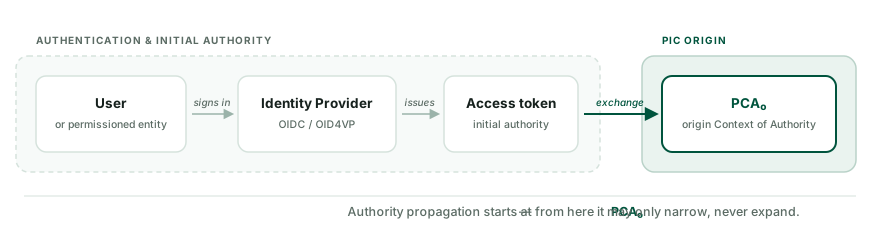
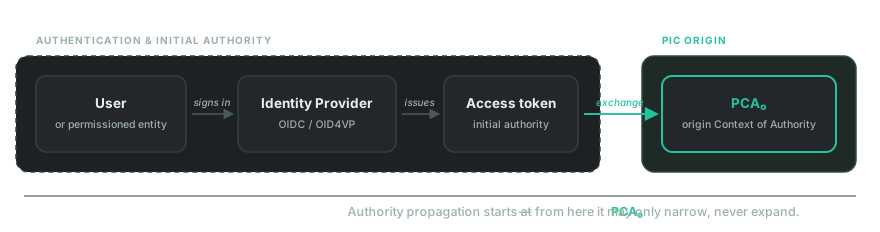
Everything on this page happens after that point. The question is no longer how authority is established — it is how the authority already established travels.
The problem
In distributed systems and AI agents, execution does not stay in one place: a request crosses services, workloads, tools, and downstream calls. The authority created at the origin must travel with it.
This is the authority propagation problem: at every step, how do we know that the authority being exercised is a valid continuation of what the origin created — and not authority reconstructed, expanded, or borrowed from an unrelated context? Possession of a token or credential proves who holds an artifact, not which execution caused its use. Left unsolved, this gap produces the confused deputy, privilege escalation, and ambient authority.
PIC's shape is small:
| Step | Meaning |
|---|---|
| Origin | Establish a root PCA from permissioned intent. |
| Hop | Prove relationship to the predecessor and keep authority non-expansive. |
| Chain | Compose those hops as Proof of Continuity. |
In Profile 0.2, each accepted advancement is settled into the next trusted PIC Token JWT.
Permissions, Intent, Authority and Execution
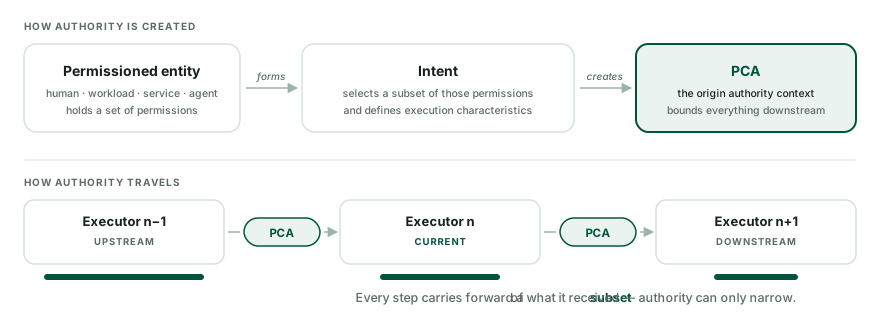
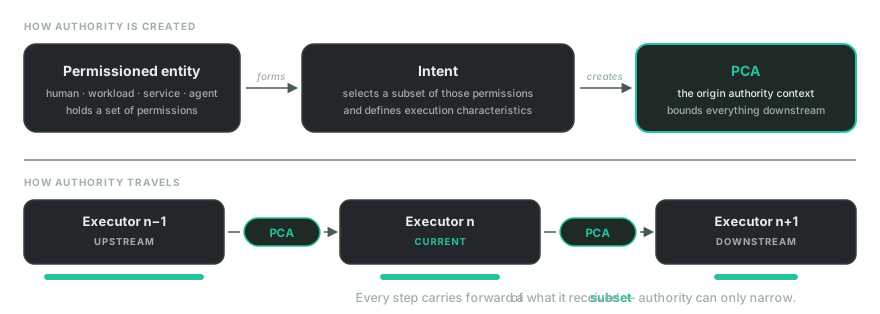
Authority propagation begins with a permissioned entity: an entity that holds a set of permissions. It may be a human identity, a non-human identity — a workload, a service, an AI agent — a role, a service account, or any other authenticated entity with permissions.
Through an intent, the permissioned entity selects a subset of its available permissions and defines the execution characteristics — the constraints under which they may be exercised. From that selection, authority is created: the entity is the origin, and the selected subset becomes the origin authority context that is propagated through execution and bounds everything that follows. The entity may act directly or through delegation; in both cases, the origin is the entity whose permissions bound the execution.
Execution Chain
From the origin, execution begins. Execution is a causal chain of executors: each step is caused by the previous one and carries forward a subset of the authority received from the origin. Each executor exists in relation to its neighbors:
- Upstream executor: the previous peer in the execution chain
- Current executor: the active principal carrying authority at this step
- Downstream executor: the next peer to which authority may be passed
These may also be referred to as previous peer, self, and next peer — or by any equivalent identifiers that make the causal relationship explicit.
At a receiving boundary, the question is not "does this executor possess a valid artifact?" It is:
Is this authority state the next valid, non-expansive continuation of the predecessor state?
Execution Constraints
Every step is also bounded by constraints restricting how, when, and where authority can be exercised: temporal (valid time window), contextual (environmental conditions), operational (subset of permitted operations). Constraints are monotonically non-increasing: they can only narrow at each step, never expand beyond the origin.
For an example of how governance is applied to an execution chain, see ZTAuth*.
Authority is created from intent and propagated through execution. At every step, it can only stay the same or narrow.