The N+1 Invalid State Problem
Executor n+1 Sees Only the State
Distributed execution is a causal chain: executor n acts, and executor n+1 continues. Looking backward, the predecessor is always known: n+1 knows exactly which executor handed it the state. Looking forward, n+1 itself may be known in advance or still unknown — not yet provisioned when the chain began (see The N+1 Unknown Executor Problem). This problem does not depend on that distinction: the invalid state is created at n, and it reaches n+1 whether n+1 was known or unknown.
Knowing the predecessor, however, does not mean knowing what it did. Executor n+1 cannot inspect the code that ran at n, cannot observe its intent, cannot replay what happened before. Everything it knows is contained in the security state it receives. Its entire authorization decision reduces to one question: is this state valid?
What No Protocol Can Prevent
No security protocol can prevent a bug inside an executor. If executor n receives authority to read and its
application logic performs a write, nothing in the protocol can stop it: the deviation happens inside code, at the
endpoint, after every check has already passed. Misbehaving application logic — bugs, defects, compromise — is
physically beyond the reach of the protocol itself.
This is not a weakness of one design or another; it is the boundary of the problem space. A protocol governs the security state that travels between executors — not what code does inside one.
The One Guarantee That Matters
Because local misbehavior cannot be prevented, a security protocol must be correct at the single point that is within its reach: executor n — buggy or malicious — must never be able to hand executor n+1 an invalid state that validates. An invalid state is a state that violates the authority of the lineage; if it is nonetheless accepted as valid, n has convinced n+1 to do something the originating caller never had permission for.
The distinction matters because of scale. A bug confined to executor n is a local incident. A bug that can forge a state that validates at n+1 turns every downstream executor into its amplifier.
When the Protocol Fails, Valid Is Valid
If a protocol fails to prevent a bug from creating a state that validates, that state will be executed and propagated. Executor n+1 has no way to know that what it received derives from a bug: every artifact is correctly signed, correctly attenuated, fully compliant. Valid is valid — so it continues. And at the next hop, n+1 becomes the new n: the forged authority propagates, each executor faithfully extending an authority the origin never granted.
Example: A Bug Composes an Invalid Security State
An executor rarely holds a single authority: it holds many at once — its own ambient privileges, delegated tokens, credentials belonging to concurrent lineages. In capability systems — and in every model that ignores the temporal dimension — lineages are flattened: an artifact, once held, is usable in any execution, and nothing keeps each authority bound to the lineage it belongs to. Authority belonging to one lineage can then be drawn into another — this is authority mixing, and it does not even require composition: it is enough for an executor to select the wrong source, satisfying a request with an authority the requester never had. That is the classic confused deputy.
Composition is the sharpest instance — a bug merges two individually valid authorities into a state no origin ever granted:
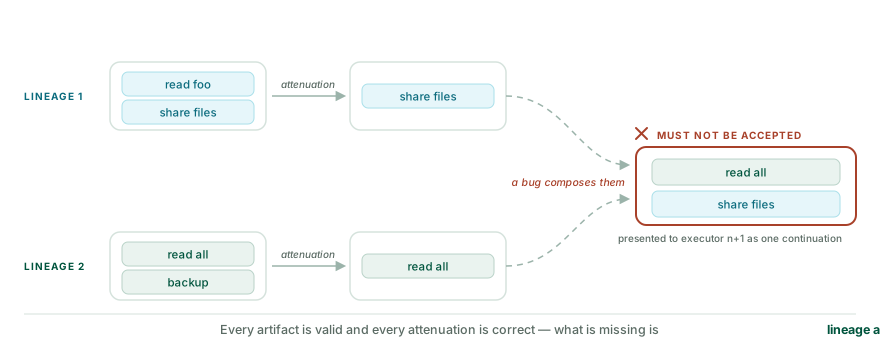
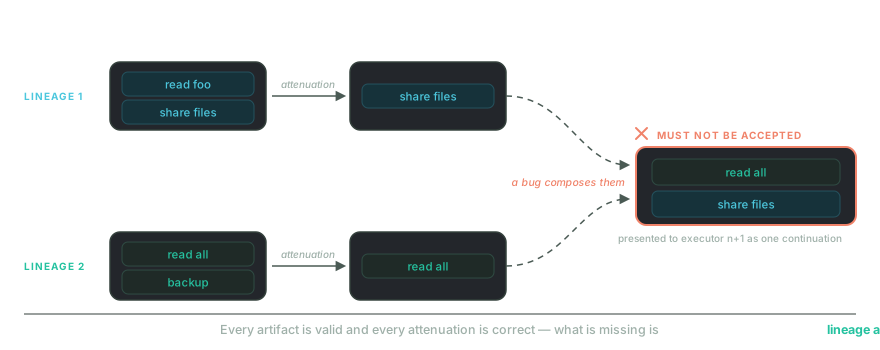
Consider two concurrent lineages flowing through the same executors:
- Lineage 1 originates with
read foo, share filesand is attenuated toshare files. - Lineage 2 originates with
read all, backupand is attenuated toread all.
At executor n, an application bug composes the read all capability from lineage 2 with lineage 1's
share files, and passes the result downstream. Executor n+1 receives read all, share files and continues,
unaware — whether it was known in advance or provisioned only after the lineages began makes no difference.
Every artifact in that state is individually valid: correctly attenuated, correctly signed. The bug has created an
invalid state that validates. Yet the origin of lineage 1 never granted read all: authority is violated while
the security protocol is fully satisfied.
The problem is not limited to composition: any use of an authority outside the lineage that caused the request — selected, borrowed, or merged — is the same mismatch. In these models the violation is invisible at the protocol level, so safety rests on the behavior and posture of whoever builds and operates the system: avoid bugs, audit code, trust every executor in the chain. The model itself cannot help.
Authority Continuity: The Application Can Misbehave, the Invalid State Cannot Be Created
PIC does not exclude the bug — no protocol can. What it removes is the bug's power to produce an invalid state that validates.
With authority continuity, every authority context is bound to the lineage that caused it. Using authority
across lineages — by selection or by composition — is not a valid transition: there is no Proof of Relationship
linking lineage 2's read all to lineage 1's chain, so the mixed state is not representable in the model. The
bug may still execute, but the state it attempts to build can never validate: executor n+1 never faces the
dilemma, because an invalid state can never reach it as valid.
The receiving check is deliberately boring:
same predecessor lineage?
valid Proof of Relationship?
non-expansive successor authority?
profile-required request, integrity, and freshness checks?
As with the N+1 unknown executor problem, Proof of Continuity solves it by respecting lineage across space and time: each hop is authorized only against the authority context of the lineage that caused it. Authority sources may be carried together, but they are never merged into a combined authority.
Not detection, not mitigation: at a conforming executor n+1, an invalid mixed authority state is not valid PIC state — even in the presence of bugs upstream.